What Is a Silent Disco and How Does It Work?
It Sounds Like a Contradiction
A silent disco. The phrase doesn’t quite make sense at first. A disco, by definition, is a place where music plays and people dance. Silent implies none of that is happening. Put the two words together and you’re left with something that sounds either very boring or very strange.
Quick Definition:
A silent disco is a dance event where guests wear wireless headphones instead of listening to speakers. Multiple music channels are broadcast at once, and each guest chooses what they want to hear.
It is neither. In fact, a silent disco is one of the most visually energetic, interactive event experiences you can offer guests — it just delivers that energy in a way most people haven’t experienced before.
The confusion is understandable. If you haven’t been to one, the name does nothing to explain what’s actually happening. This article does. By the end, silent discos will make complete sense — and you’ll understand why they have become a fixture at everything from music festivals to corporate events to school dances.
What Is a Silent Disco?
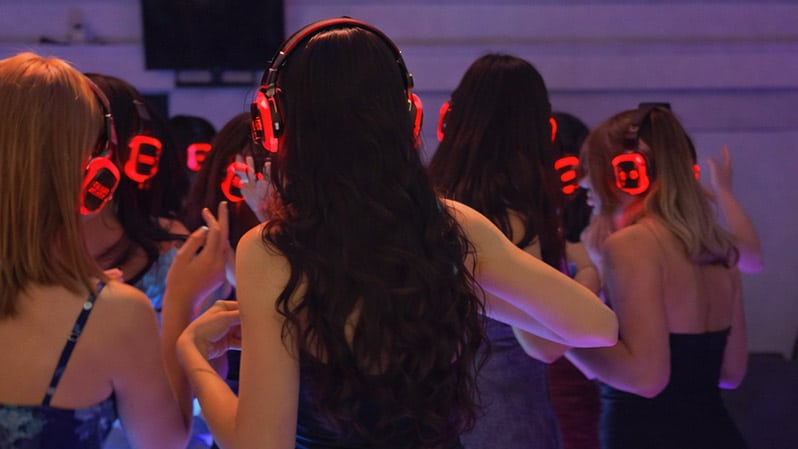
A silent disco is a dance event where guests listen to music through wireless headphones instead of speakers. There is no sound coming from the room itself — the music exists only inside the headphones each guest is wearing. What makes it genuinely interesting is that those headphones usually offer more than one music channel. Guests can switch between channels — say, channel one playing hip-hop, channel two playing pop, and channel three playing classic hits — and they choose what they want to hear at any given moment. The headphones are LED-lit, which means each channel is assigned a color. When you look across a room full of silent disco guests, you can see at a glance what everyone is listening to. A cluster of green headphones is dancing to one song. A cluster of red headphones is dancing to something completely different. They are in the same room, on the same floor, at the same moment — but living in entirely different musical experiences.The room is silent to anyone not wearing headphones. To the people wearing them, it is a full dance event with the volume exactly where they want it.
How Does a Silent Disco Work?
The setup is simpler than it sounds. Here is what is actually happening behind the experience:
The Headphones
Each guest receives a pair of wireless LED headphones when they arrive or enter the dance area. The headphones are rechargeable, lightweight, and designed for extended wear. They have a volume dial so each guest controls their own listening level, and a channel selector button to switch between the available music streams.
The Transmitters
The music does not travel through speakers. Instead, each DJ or playlist source feeds into a radio transmitter, which broadcasts the audio signal wirelessly across the event space. The headphones pick up that signal. The range is typically large enough to cover an entire venue floor, an outdoor courtyard, or even a sprawling festival area.
The Channels
Most silent disco setups offer two or three simultaneous channels. Each channel is a separate music source — a different DJ, a different genre playlist, or a different themed music stream. Guests switch channels by pressing a button on the headset. The LED color changes instantly to indicate which channel they are on.
What Guests Experience
From the guest’s perspective, the experience is seamless. You put on the headphones, pick a channel, and start dancing. You can turn up the volume, switch channels if the current song isn’t your style, or pull the headphones down briefly to talk to someone next to you. You are in complete control of your own experience while still being part of a shared event.
Visual note: From outside the headphones, what you hear is people singing along to music you cannot hear, laughing, and dancing in apparent silence. To people unfamiliar with the format, watching a silent disco for the first time is genuinely surprising.
Why Silent Discos Became Popular
Silent discos were not invented as a novelty. They emerged as a practical solution to a common problem: noise. Outdoor festivals, rooftop venues, hotel event spaces, and residential areas all carry sound restrictions that make traditional loud music impractical or impossible past certain hours. Silent discos bypassed that limitation entirely. No speakers means no noise complaints, no decibel violations, and no early shutdowns. Once the format was established as a solution to noise restrictions, event planners and entertainers discovered something else: guests genuinely loved the experience. The ability to choose between channels gave people agency that a standard DJ set doesn’t offer. The visual spectacle of a room full of LED headphones created a shared experience that photographs and videos extremely well. The novelty of the format became a feature, not just a workaround. What started as a workaround for sound ordinances at European festivals has now become standard at events worldwide. Over time, the format spread from outdoor festivals to indoor corporate events, school dances, fitness classes, wedding after-parties, and private celebrations — not because they needed to avoid noise, but because guests enjoy the experience itself.What Types of Events Use Silent Discos
The format works across a surprisingly wide range of events including weddings, corporate events, and school dances. Here is where you see it most commonly:
- Schools and student events: Proms, homecoming dances, and after-prom events use silent discos because they allow multiple music genres simultaneously — something that matters a great deal when a diverse student body has different tastes. They also work well in gymnasiums and multi-purpose spaces with acoustic limitations.
- Corporate events: Company parties, team-building events, and conference after-parties use the format to create a memorable, interactive atmosphere without the noise levels that can make conversation impossible at traditional DJ events.
- Music festivals: The format originated in the festival world and remains common there, particularly for late-night stages where noise curfews would otherwise shut down the music.
- Private parties and celebrations: Birthday parties, wedding after-parties, and milestone celebrations use silent discos as a centerpiece experience — something guests talk about afterward because they have not encountered it before.
- Fitness and wellness events: Yoga classes, group fitness sessions, and wellness retreats have adopted the format because it allows an instructor to communicate verbally with participants while still providing an individualized music experience through the headphones.
Common First-Time Questions
Is it awkward?
Only for the first few minutes, and only if guests don’t understand what they’re walking into. When the format is explained at the start — here are your headphones, here are your three channels, here’s what the colors mean — the awkwardness dissolves quickly. People figure it out fast, and most guests are curious and engaged rather than confused.Do people actually dance?
Yes, consistently and enthusiastically. The individual volume control tends to remove inhibition — people are not self-conscious about dancing when the music is at exactly the level they chose. The visual energy of the room, with everyone around them moving, reinforces participation rather than discouraging it.What happens if you take the headphones off?
You hear the room — which is mostly other people singing, laughing, and moving to music you cannot hear. It is a genuinely strange and entertaining experience from the outside. Many guests pull their headphones off briefly just to observe it, then put them back on. The contrast between the two perspectives is part of what makes the format memorable.Can people talk to each other?
Yes. You pull the headphones down or off, talk, then put them back on. Some guests keep one ear covered and one ear free for most of the night. The format actually makes conversation easier at points than a traditional loud DJ event, because you are not competing with speakers at full volume.What a Silent Disco Is Not
A few misconceptions are worth clearing up directly.
- Not quiet. The room may be silent to an outside observer, but inside the headphones the music is as loud as the guest chooses. The experience is not calm, subdued, or ambient unless the guest deliberately turns the volume down.
- Not passive. Silent disco guests are active participants. They are choosing channels, adjusting volume, reacting to songs, singing along, and dancing. The experience requires more engagement than a traditional event where one playlist plays whether you like it or not.
- Not boring. The visual energy of a room full of dancing people wearing LED headphones — with the occasional burst of singing audible from those who forgot the room was silent — is consistently described by first-time observers as one of the more entertaining things they have watched at an event.
- Not a gimmick, when done correctly. Any format can feel gimmicky if it is not executed well. A silent disco with thoughtfully curated channels, properly fitted headphones, an experienced operator, and a crowd that understands what to expect is a complete, high-quality event experience — not a novelty act.
Why People Remember Silent Discos
Most events are experienced and forgotten within a few weeks. Silent discos tend to stay in people’s memory longer than average, and there are a few consistent reasons for that.
Choice and control are not common features of shared entertainment experiences. At most events, you listen to whatever is playing. At a silent disco, you decide. That agency makes the experience feel personal even when you are sharing it with hundreds of other people.
The visual energy is unlike any standard event. A dance floor full of LED-lit headphones glowing in two or three colors, with people moving to music only they can hear, is visually arresting. It is the kind of scene guests photograph and share — not because they were asked to, but because it looks unlike anything else.
The outside-the-headphones moment — when a guest pulls off their headphones and hears the room — is consistently described as one of the most memorable parts of the experience. That contrast between the rich, full music inside the headphones and the near-silence of the room creates a perspective shift that sticks with people.
Taken together, these elements create an experience that feels both shared and individual — which is a difficult combination to achieve at any event, and one that explains why the format has grown far beyond its practical origins.
A Silent Disco Is an Experience, Not Just Equipment
The name is still a little confusing. That is probably not going to change. But what happens inside a silent disco — the music choices, the channel switching, the visual spectacle, the conversations held with one headphone on and one off — is not confusing at all once you have seen it or been part of it.
The headphones are the delivery mechanism. The experience is what matters. And when the experience is designed well — with the right channels, the right crowd energy, and a clear introduction for guests who have never done it before — it is one of the most reliably engaging formats available for any event.
Once you have been to a silent disco, the name finally makes sense. And you will probably want to go back.